Safety, Searches and Student Rights
In recent years, concerns about school violence have pushed administrators to act quickly—sometimes within minutes—when a student is reported to have made a gun-related comment. At the same time, parents rightly ask where the constitutional limits lie.
Two recent Sixth Circuit decisions, combined with new Tennessee statutes, now provide the clearest roadmap yet for how courts evaluate student searches, student “seizures,” and school discipline based on perceived threats. The most significant of these decisions is a December 2025 opinion from the Sixth Circuit, Halasz v. Cass City Public Schools, which for the first time formally defined when a student is “seized” under the Fourth Amendment in a school setting.
When read together with Johnson v. Russell and Tennessee’s statutory framework, the law reveals a consistent theme: schools receive broad deference to protect safety, but that discretion is not unlimited.
The Halasz Case: Safety Investigations After Gun-Related Statements
In Halasz, an eighth-grade student was accused of making comments about bringing a gun to school. The timing mattered. The reports occurred one week after a mass school shooting in a nearby county, a fact the court repeatedly emphasized.
School officials responded by:
Searching the student’s person, backpack, and locker
Interviewing the student in a school office for approximately 30 minutes
Involving a state police officer during the investigation
Ultimately imposing a 180-day expulsion
No weapon was found at school or later at the student’s home. The parents sued, alleging violations of the Fourth Amendment, due process, and state law. The Sixth Circuit rejected every claim.
A New Sixth Circuit Rule: When Is a Student “Seized”?
For years, courts had avoided clearly defining when a student is “seized” at school. Halasz resolved that question.
The Sixth Circuit held that a student is seized only when school officials restrict the student’s movement in a way that significantly exceeds the limitations inherent in everyday, compulsory attendance.
Because students are already required to:
attend school,
remain in classrooms, and
comply with administrative directions,
not every trip to the office or interview constitutes a seizure. In Halasz, holding the student in the office while assessing a reported gun threat did not exceed that baseline.
Extending the T.L.O. Standard to Seizures
Traditionally, New Jersey v. T.L.O. governed searches of students, allowing them when:
Justified at inception, and
Reasonable in scope.
In Halasz, the Sixth Circuit extended that same framework to student seizures.
This means:
Probable cause is not required
Reasonable suspicion is enough
The detention must be limited in time and purpose
A 30-minute interview tied to a credible safety concern was deemed reasonable.
Searches Without a Weapon: Still Constitutional
One of the most difficult points for families is this: the absence of a weapon does not retroactively invalidate a search or discipline.
The court reaffirmed that:
Schools may act on credible reports
Miranda warnings are not required during school discipline interviews
Parents need not be contacted before an emergency safety search
Police involvement does not automatically transform a school investigation into a criminal one
What matters is whether school officials acted reasonably based on what they knew at the time.
Due Process and Expulsions: Procedure, Not Outcome
The parents in Halasz argued the expulsion hearing was unfair because administrators did not disclose that police later concluded the student posed no immediate danger.
The court disagreed.
Due process in school discipline requires:
Notice of the allegations
An explanation of the evidence
An opportunity to respond
It does not require administrators to disclose every potentially favorable fact or to reach the “best” decision—only a fair one. The student was expelled for making the statements, not for possessing a gun, and the procedures satisfied constitutional requirements.
Johnson v. Russell: Where School Authority Can Break Down
Halasz must be read alongside another 2025 Sixth Circuit case: Johnson v. Russell.
In Johnson, the court addressed allegations of:
A highly intrusive search requiring a student to pull down his pants
Confinement in a locked, windowless room
The Sixth Circuit cautioned that while safety concerns are paramount, excessively intrusive searches and isolating confinement—absent individualized justification—can strip school officials of qualified immunity. These facts helped shape the seizure limits later articulated in Halasz.
Tennessee Law Adds Additional Safeguards
Federal constitutional law sets the floor. Tennessee law now adds meaningful guardrails.
Enhanced Search Requirements (TCA § 49-6-4204)
Effective in stages through July 2025, Tennessee law limits who may conduct physical searches on school property. Searches may be performed only by:
School Resource Officers acting as school officials
School security officers
Trained school administrators
For students under 18, principals must notify parents within a reasonable time after a search.
Mandatory Threat Assessments (TCA § 49-6-3401)
When a student faces discipline for a zero-tolerance offense involving threats of mass violence:
The Director of Schools must require a threat assessment
If the threat is deemed not valid, the student may not be expelled for a zero-tolerance offense
Other disciplinary measures may still apply
This statutory protection is often overlooked and can be outcome-determinative.
What This Means for Tennessee Families and Schools
Courts will continue to give schools wide latitude to respond to credible safety threats—especially those involving firearms. At the same time, procedural compliance matters, particularly under Tennessee law.
Parents should understand that statements alone can trigger serious consequences. Schools must ensure that their responses are proportional, documented, and compliant with both constitutional and statutory requirements.
Practical Guidance at a Glance: Searches, Seizures, and Threats in Tennessee Schools
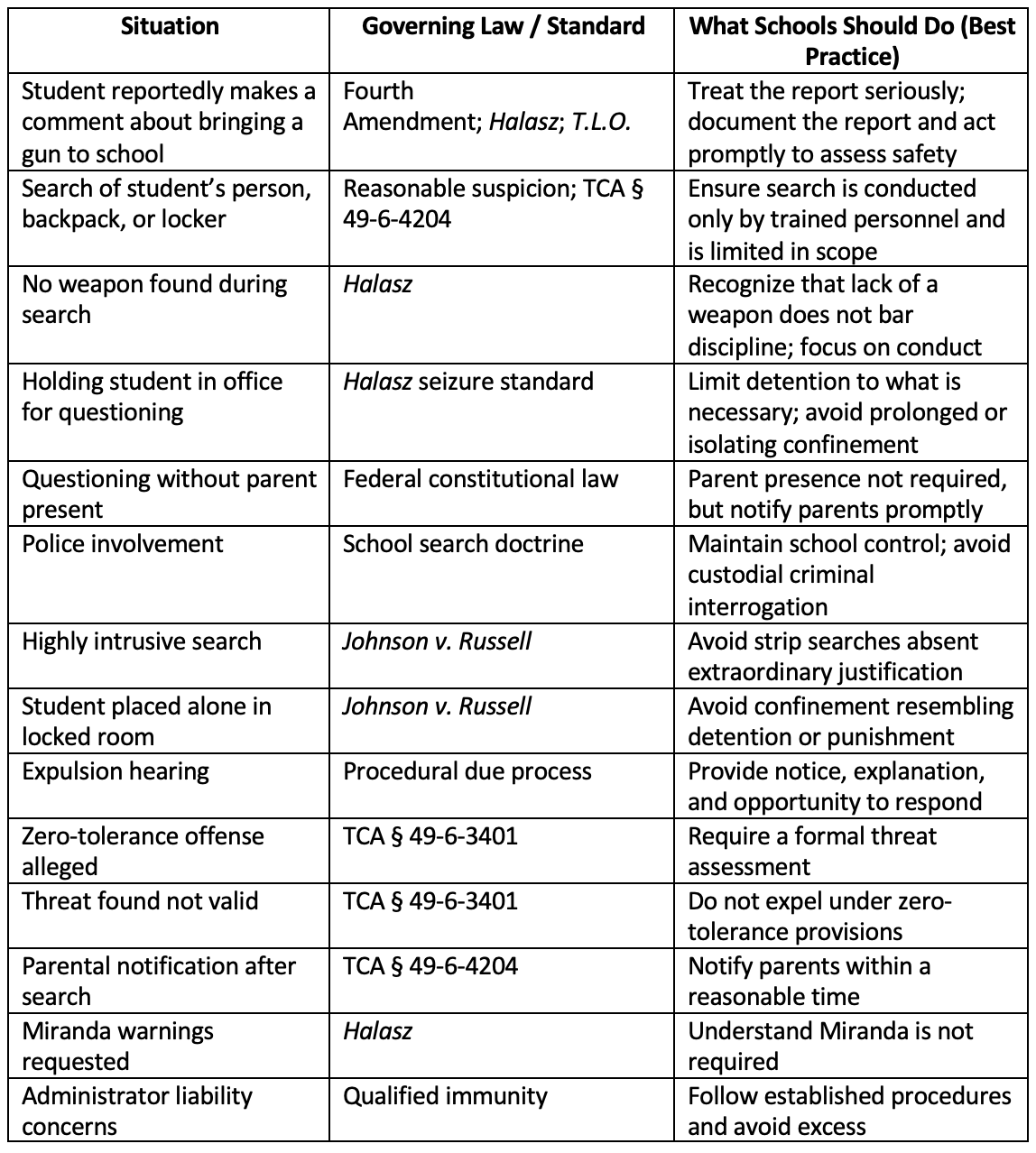
Cases involving student searches, seizures, and alleged threats are intensely fact-specific. What may be lawful and appropriate in one situation can cross constitutional or statutory lines in another—especially under Tennessee’s evolving school safety laws. If your child or school is facing a discipline issue involving searches, questioning, or allegations of violence, it is important to evaluate the facts early and carefully. If you need guidance, you can contact me through this website to discuss the situation and your options.