Sixth Circuit Strikes Down School Pronoun Ban: What You Need To Know
Public schools today are walking a tightrope: protecting all students from harassment while navigating deeply personal beliefs about gender identity. A new Sixth Circuit decision — which governs Tennessee — just set an important First Amendment boundary that every district needs to understand.
In Defending Education v. Olentangy Local School District (6th Cir. 2025), the Court ruled that a school district cannot punish students for respectfully using pronouns consistent with a classmate’s biological sex, even when those pronouns differ from the classmate’s preferred pronouns.
The decision is not about hostility. It is about the constitutional limits on regulating student speech.
The Policy at Issue
Olentangy’s policy treated any “misgendering” — even non-hostile and non-targeted — as harassing conduct. Students with sincere religious or biological views about sex were told they must use preferred pronouns or face discipline.
Parents challenged the policy as:
Compelled ideological speech
Viewpoint discrimination
Overbroad regulation of student expression
The federal district court initially sided with the school district. But the Sixth Circuit reversed — and the ruling applies directly to Tennessee schools.
What the Court Held
The Court concluded:
“The commonplace use of biological pronouns is protected speech.”
To justify restricting speech, a district must show either:
A material and substantial disruption to school operations, or
A true invasion of the rights of others
Offense alone is not enough.
The Sixth Circuit emphasized that public schools may not impose one ideological position on issues of gender identity. Forcing students to use preferred pronouns is viewpoint discrimination — the most dangerous kind under the First Amendment.
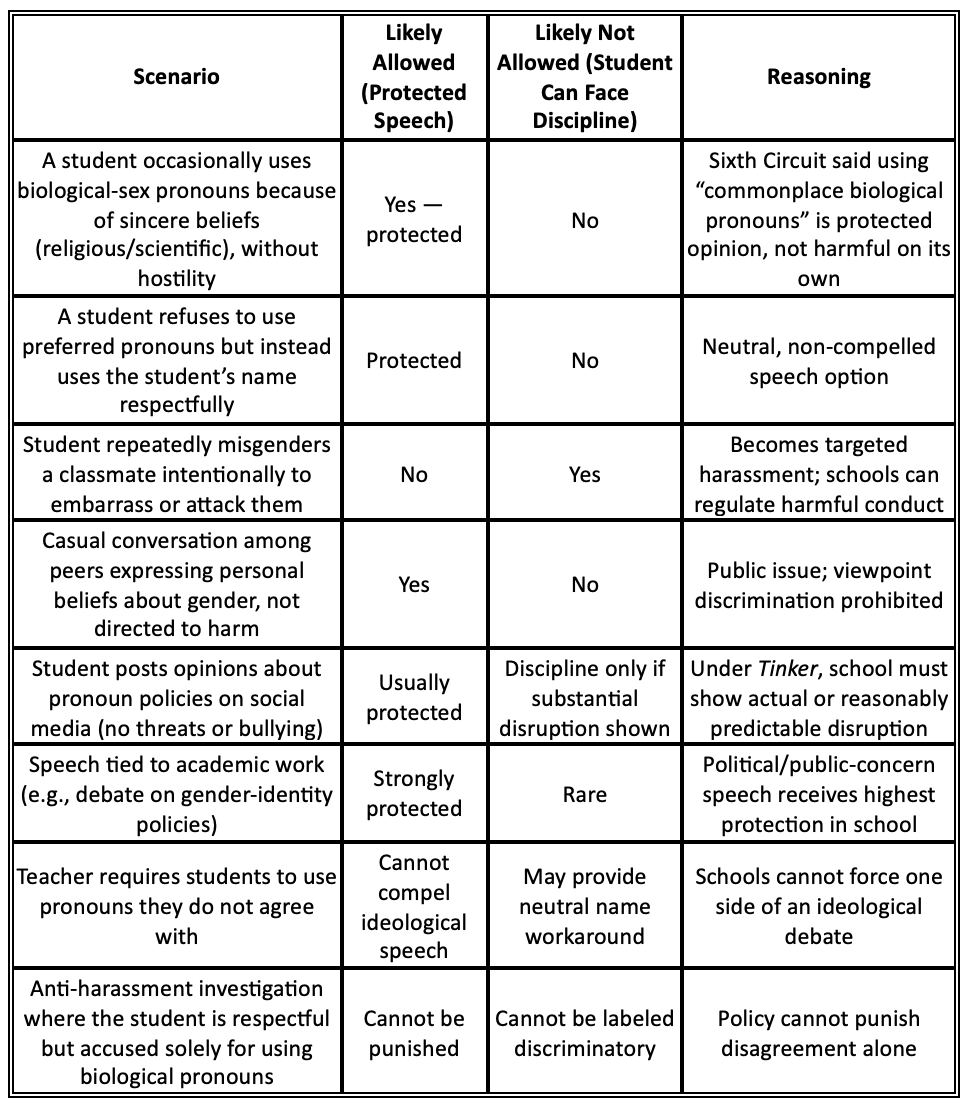
Essentially, Harassment and Bullying are not Protected
Tennessee Application: Sixth Circuit + Public Chapter 453
Tennessee now has a two-layer protection for students and employees when it comes to pronoun usage:
Federal Law — After Defending Education v. Olentangy Local Schools Ruling
Districts cannot punish non-hostile use of biological pronouns or compel speech affirming a particular gender ideology unless speech crosses into true harassment or disruption.
Tennessee State Law — Public Chapter 453
PC 453 reinforces and expands those protections:
Schools may not require students or staff to use pronouns inconsistent with a person’s biological sex.
A student cannot be disciplined for declining to use preferred pronouns.
For minor students, staff may not use a preferred name or pronoun inconsistent with legal name or biological sex without written parental consent.
Staff and contractors receive civil immunity if they choose not to use requested pronouns.
What This Means for Tennessee LEAs Right Now
Districts must:
1. Review and revise policies that discipline students or teachers for declining preferred pronouns
2. Update bullying/harassment investigations to focus on targeted, harmful conduct
3. Secure parental consent before using alternate pronouns or names for minors
4. Avoid compelled speech or viewpoint-based enforcement
Failing to comply now exposes districts to:
1. First Amendment liability (federal suit) and
2. Tennessee statutory violations (PC 453 claims and damages)
Practical Steps for Administrators
Dress policies in neutral language
Focus on conduct (harassment, bullying) — not disagreement or ideology.Train principals and staff
Ensure they understand when student speech is protected.Document actual disruption
Don’t discipline merely because a comment was offensive.Use parental-consent procedures for minors’ preferred pronouns/names.
Final Thought
Gender identity is a sensitive and personal topic for many families. Schools should be places where every student feels respected — and where differences of belief are not grounds for punishment. This Sixth Circuit decision, reinforced by Tennessee’s new legal requirements, provides a clear and practical standard:
Schools may regulate conduct that harms other students, but they may not compel students to affirm an ideology they do not share.
When districts stay focused on preventing real bullying or harassment — and avoid disciplining respectful disagreement — they support all students: those who hold traditional or faith-based views, and those who identify differently. That is how Tennessee public schools can protect student dignity and ensure they remain firmly within constitutional boundaries.